

Heatwaves are no longer a rare event. They’re the new normal — and your garden needs to be ready for them.
A low-maintenance gravel garden is a dry garden style that uses crushed stone, gravel mulch, and drought-tolerant plants to create a landscape that thrives with minimal water, weeding, and upkeep. Instead of fighting the heat, it works with it.
According to the UK Met Office, 2023 recorded the hottest June ever in parts of England, with soil moisture deficits hitting record lows. In the US, the NOAA reported that 2023 was the warmest year on global record. In 2026, those numbers are trending higher — not lower.
The problem? Most traditional gardens are not built for this. Lawns brown out. Borders wilt. Water bills spike. Gardeners burn out.
The solution is gravel. Done right, a gravel garden can cut your watering time by up to 80%, eliminate most weeding, and look stunning through July heat that kills everything else. This guide shows you exactly how to build one — with real data, actionable steps, and zero fluff.
What Exactly Is a Low-Maintenance Gravel Garden — and Why Does It Work?
A low-maintenance gravel garden uses gravel as a surface mulch over free-draining soil, planted with drought-adapted species that need little water or care once established.
The science behind it is simple. Gravel acts as a moisture regulator. It reflects intense solar radiation before it reaches the soil surface, keeps the root zone cooler than bare earth, and dramatically reduces evaporation. A 2019 study published in Urban Forestry & Urban Greening found that gravel mulch reduced soil moisture loss by up to 40% compared to uncovered soil during high-temperature periods.
Combine that with plants that evolved in Mediterranean, steppe, or alpine climates — lavender, sedums, ornamental grasses, alliums, salvias — and you have a garden that shrugs off drought. These plants have deep root systems, waxy or silver leaves that reflect sunlight, and a natural ability to go semi-dormant under stress without dying.
The result: a garden that actually looks better in a heatwave than it did before one.
How Do You Choose the Right Gravel for a Heat-Resilient Garden?
Use angular, light-coloured gravel — ideally limestone, quartzite, or pea gravel — in a depth of 5–7 cm for maximum heat reflection and weed suppression.
Not all gravel is equal. Here’s what matters when choosing:
- Colour: Light gravel (cream, buff, white) reflects heat. Dark gravel (slate, basalt) absorbs it and raises soil temperature — bad for roots during a heatwave.
- Texture: Angular gravel locks together and resists washing in rain. Smooth pea gravel looks clean but migrates easily.
- Size: 10–20mm is the sweet spot. Too fine and it compacts; too large and it’s hard to walk on and plants struggle to self-seed.
- Depth: Lay a minimum of 5cm. Less than this and weeds break through. More than 8cm and seedlings can’t establish easily.
A useful comparison:
| Gravel Type | Heat Reflection | Weed Control | Cost (per tonne) | Best Use |
|---|---|---|---|---|
| Buff limestone | High | Excellent | £40–£70 | Borders, paths |
| White quartzite | Very High | Excellent | £60–£100 | Feature areas |
| Pea gravel | Medium | Good | £30–£55 | Informal areas |
| Slate chippings | Low | Good | £45–£80 | Contemporary style |
Skip the weed membrane beneath gravel if you want plants to self-seed naturally — which is part of what makes a gravel garden look alive and dynamic. If you want zero maintenance, use a permeable landscape fabric, but accept that self-seeding won’t happen.
Which Plants Survive Heatwaves Best in a Gravel Garden?
Choose plants from Mediterranean, South African, or steppe climates. They are genetically wired to handle heat, poor soil, and dry spells without intervention.
Here are the top performers validated by the RHS (Royal Horticultural Society) and proven in UK and US heat trial gardens:
Structural Plants (the backbone)
- Lavandula angustifolia ‘Hidcote’ — Intensely fragrant, silvery foliage, drought-proof after year one. RHS Award of Garden Merit holder.
- Stipa tenuissima (Mexican feather grass) — Moves beautifully in wind, thrives in heat, requires no watering once established.
- Eryngium (sea holly) — Metallic blue flowers in peak summer. Thrives in poor, dry soil. Heatwave-proof.
- Festuca glauca — Steel-blue ornamental grass. Compact, evergreen, needs zero care.
Flowering Plants (seasonal colour)
- Salvia nemorosa ‘Caradonna’ — Deep purple spikes from June to September. Repeat-flowers if cut back. Extremely drought-tolerant.
- Echinacea purpurea — American prairie native. Survives long dry periods. Pollinators love it.
- Allium hollandicum ‘Purple Sensation’ — Dramatic globe flowers in late spring. Bulb goes dormant in heat — it doesn’t die, it rests.
- Sedum spectabile (Ice Plant) — Late summer bloomer. Fleshy leaves store water. Handles drought with ease.
Ground Cover (fills gaps, suppresses weeds)
- Thymus serpyllum — Creeping thyme. Fills gaps between stones beautifully. Edible. Zero water needed.
- Sempervivum (houseleeks) — Hardy succulents. Spread slowly. Handle extreme heat without water.
Case Study — The Beth Chatto Gravel Garden, Essex, UK: Established in 1992 on a car park with no irrigation whatsoever, this garden has survived every summer drought since — including the extreme 2022 UK heatwave (40.3°C). It’s maintained by two part-time gardeners and receives zero supplemental watering. It remains one of the most visited dry gardens in Europe and a living proof that this approach works at scale.
How Do You Prepare the Ground Before Laying Gravel?
Good soil preparation is the single most important step. It determines whether your plants establish quickly or struggle for years.
Follow this sequence:
- Clear the area. Remove all existing vegetation. Spot-treat perennial weeds like bindweed or couch grass with a targeted weedkiller six weeks before planting. Don’t rush this step.
- Improve drainage. If your soil is clay-heavy, dig in horticultural grit or coarse sand at a ratio of 30–40% by volume. Clay soil holds water around roots, which causes root rot in drought-adapted plants. They prefer to dry out between waterings.
- Do not add compost or fertiliser. This is counterintuitive, but Mediterranean plants perform best in poor, lean soil. Rich soil pushes lush, weak growth that wilts in heat.
- Rake level and firm down. You want a flat, firm base that won’t sink under gravel weight.
- Plant first, gravel second. Get all plants in the ground before laying gravel. Work around root balls when spreading gravel, and pull it back 2–3cm from each stem to prevent crown rot.
What Is the Most Efficient Layout for a Gravel Garden That Handles Extreme Heat?
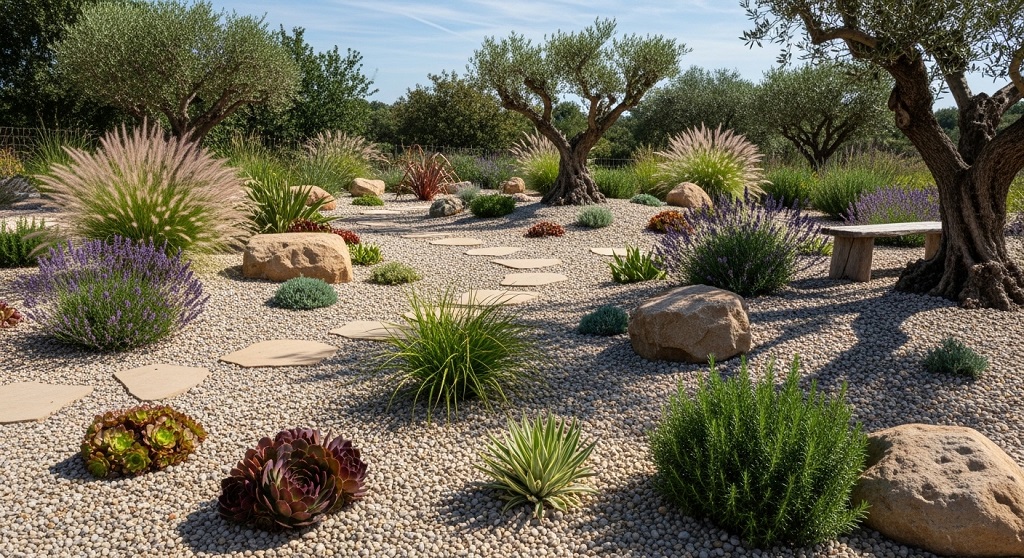
Use an irregular, naturalistic layout — not formal rows. Group plants in odd numbers, vary heights dramatically, and leave open gravel spaces between clumps for visual breathing room and heat management.
Key layout principles for heat resilience:
- Use south or southwest-facing slopes where possible. These get the most sun and drain fastest — perfect for dry-garden plants.
- Create height variation. Tall grasses at the back, medium perennials mid-ground, creeping ground covers at edges. This mimics a natural steppe landscape and creates airflow that reduces fungal problems in humid heat.
- Leave 30–50cm between plants. It looks sparse the first year. By year two, it looks intentional. This spacing allows airflow, reduces root competition, and gives gravel a chance to show.
- Incorporate boulders or large stones. They create shade pockets beneath them where soil stays cool and moist longer. Plant low sedums or sempervivums next to them — they benefit from the cooler microclimate.
- Avoid low-lying areas. Water pools there after rain. Drought-tolerant plants hate wet feet. Raise or redirect these spots if possible.
How Much Does a Gravel Garden Cost to Install — and What’s the Return?
A DIY gravel garden costs approximately £15–£30 per square metre. Professional installation runs £50–£120 per square metre. The payback comes through reduced water bills, near-zero maintenance costs, and increased property appeal.
Here’s a realistic cost breakdown for a 25m² project:
| Item | DIY Cost | Professional Cost |
|---|---|---|
| Gravel (3–4 tonnes) | £150–£250 | £150–£250 |
| Plants (20–30 specimens) | £80–£150 | £120–£200 |
| Soil amendment (grit/sand) | £40–£80 | £40–£80 |
| Labour | £0 | £900–£2,500 |
| Total | £270–£480 | £1,200–£3,030 |
A UK Water Research Council study found that replacing a 25m² lawn with a gravel-and-drought-tolerant planting scheme saves an average of 4,000–6,000 litres of water per summer. At current UK water rates, that’s roughly £8–£15 in direct savings per year — modest, but the real saving is time. A gravel garden needs roughly 2–3 hours of maintenance per season versus 40–60 hours for a comparable lawn and flower border.
How Do You Maintain a Gravel Garden Through Summer and Beyond?
Annual maintenance takes 2–4 hours total. The key tasks are a spring cut-back, top-dressing with fresh gravel every 2–3 years, and occasional hand-weeding of seedlings you don’t want.
Seasonal maintenance guide:
- Spring (March–April): Cut back ornamental grasses and perennials to 10–15cm above ground. Remove dead flower heads from last year. Top-dress with fresh gravel if needed. This is the most work you’ll do all year — and it takes under two hours.
- Early summer (May–June): Pull any weed seedlings before they set roots. After year two, this step takes about 20 minutes as the planting closes in and suppresses weeds naturally.
- Heatwave management: Do nothing. Seriously. Established drought-tolerant plants handle heat better without intervention. Do not water unless plants have been in the ground fewer than 12 months.
- Autumn (September–October): Leave seed heads standing. They look beautiful in frost, feed birds, and self-sow for next year’s plants. Only remove if diseased.
- Winter: Nothing. The garden looks after itself.
Ready to Build a Garden That Thrives While Others Wilt?
The climate isn’t going back to what it was. Heatwaves are getting longer, more frequent, and more intense — and gardening strategies built for a cooler, wetter era are failing in real time.
A low-maintenance gravel garden is not a trend. It’s a rational, evidence-backed response to the reality of gardening in 2026. It costs less to run, looks better under stress, and demands a fraction of the time a traditional garden requires.
The Beth Chatto model has proven it for over three decades. The plant science backs it up. The water savings are real. The only thing missing is the decision to start.
You don’t need to redesign your entire garden at once. Start with a 3–5 square metre test area this spring. Choose three plants from the list above. Lay your gravel. Then watch what happens during the first summer heatwave.
Ready to start? Download our free gravel garden plant selector tool, or drop your questions in the comments below — we answer every single one.
Frequently Asked Questions About Low-Maintenance Gravel Gardens
Does a gravel garden need watering during a heatwave?
Established gravel gardens (plants in the ground for 12+ months) do not need watering during heatwaves. Drought-tolerant plants draw on deep soil moisture and go semi-dormant under stress without dying. New plantings in their first summer may need weekly watering until roots reach deeper, cooler soil layers — typically a 10-minute soak once a week, early morning.
Do weeds grow through gravel?
Some do, especially wind-blown annuals. However, a 5–7cm layer of angular gravel significantly reduces weed germination compared to bare soil. Most weeds that do appear are shallow-rooted and come out easily by hand. After the planting matures and closes in (year two onward), weed pressure drops dramatically. Avoid plastic weed membrane if you want a natural-looking result — it degrades, traps debris, and makes replanting difficult.
Can I convert an existing lawn into a gravel garden?
Yes. The most effective method is to scalp the lawn short, cover it with overlapping layers of cardboard (no glossy surfaces), then top with 7–10cm of gravel. The cardboard suppresses grass and breaks down within one season. Cut planting holes through both layers for your plants. This no-dig method avoids releasing weed seeds that digging would bring to the surface.
What is the best gravel colour for a hot, sunny garden?
Light-coloured gravel — buff limestone, white quartzite, or cream flint — performs best in hot, sunny gardens. These colours reflect solar radiation rather than absorbing it, keeping soil temperature lower and protecting root zones during heatwaves. Dark gravel like slate can raise soil temperature by 4–6°C, which stresses heat-sensitive roots.
How long does it take for a gravel garden to look established?
Most gravel gardens look intentional and reasonably full by the end of year two. Year one looks sparse — this is normal and expected. By year three, well-chosen plants spread, self-seed, and fill gaps naturally. Resist the urge to over-plant in year one; crowded plants compete for water and don’t establish as strongly.
Is a gravel garden suitable for clay soil?
Yes, but soil preparation is critical. Clay soil holds too much water for most drought-tolerant plants. Before planting, dig the area to 30–40cm and mix in 30–40% horticultural grit by volume. Raised gravel beds built on top of clay with a free-draining growing medium are another proven solution and work particularly well in small spaces.
What is the difference between a gravel garden and a rock garden?
A rock garden uses large rocks or boulders as the primary structural element, with plants growing between them — typically alpine or rockery species. A gravel garden uses crushed stone or gravel as a ground cover mulch, with a wider range of drought-tolerant perennials, grasses, and bulbs. Gravel gardens tend to be larger in scale and lower in maintenance than traditional rock gardens.
Related Topics: How to Mix Cottage Garden Flowers with Native Plants
What Next: How to Compost Kitchen Waste for Your Garden (Simple Guide)
